
Refurbished Phone Grading Explained: What Do the Grades Mean?
Introduction
Buying a refurbished phone can be a great way to get a quality device without paying the price of a brand-new handset. However, one thing that can be confusing when shopping for refurbished phones is the grading system.
You may see phones described as Grade A, Grade B, Grade C, Excellent, Very Good, Good, or Fair. But what do these terms actually mean?
The answer isn’t always straightforward because there is no single universal grading system used by every refurbished-phone seller. One company’s Grade A phone may have slightly different standards from another company’s Grade A device.
In this guide, we’ll explain the most common refurbished-phone grades, what you should expect from each one, and what to check before buying.
What Does “Refurbished Phone” Mean?
A refurbished phone is generally a previously owned or returned device that has been inspected, tested, and prepared for resale.
Depending on the seller and the condition of the phone, refurbishment may involve:
- Testing the phone’s hardware
- Checking the screen and cameras
- Testing buttons and speakers
- Checking charging and connectivity
- Replacing faulty components
- Replacing a worn battery where necessary
- Cleaning the device
- Removing previous user data
- Testing the operating system
- Performing quality checks before resale
However, the exact refurbishment process can vary considerably between sellers.
That’s why it’s important to look beyond the grade itself.
What Is Grade A?
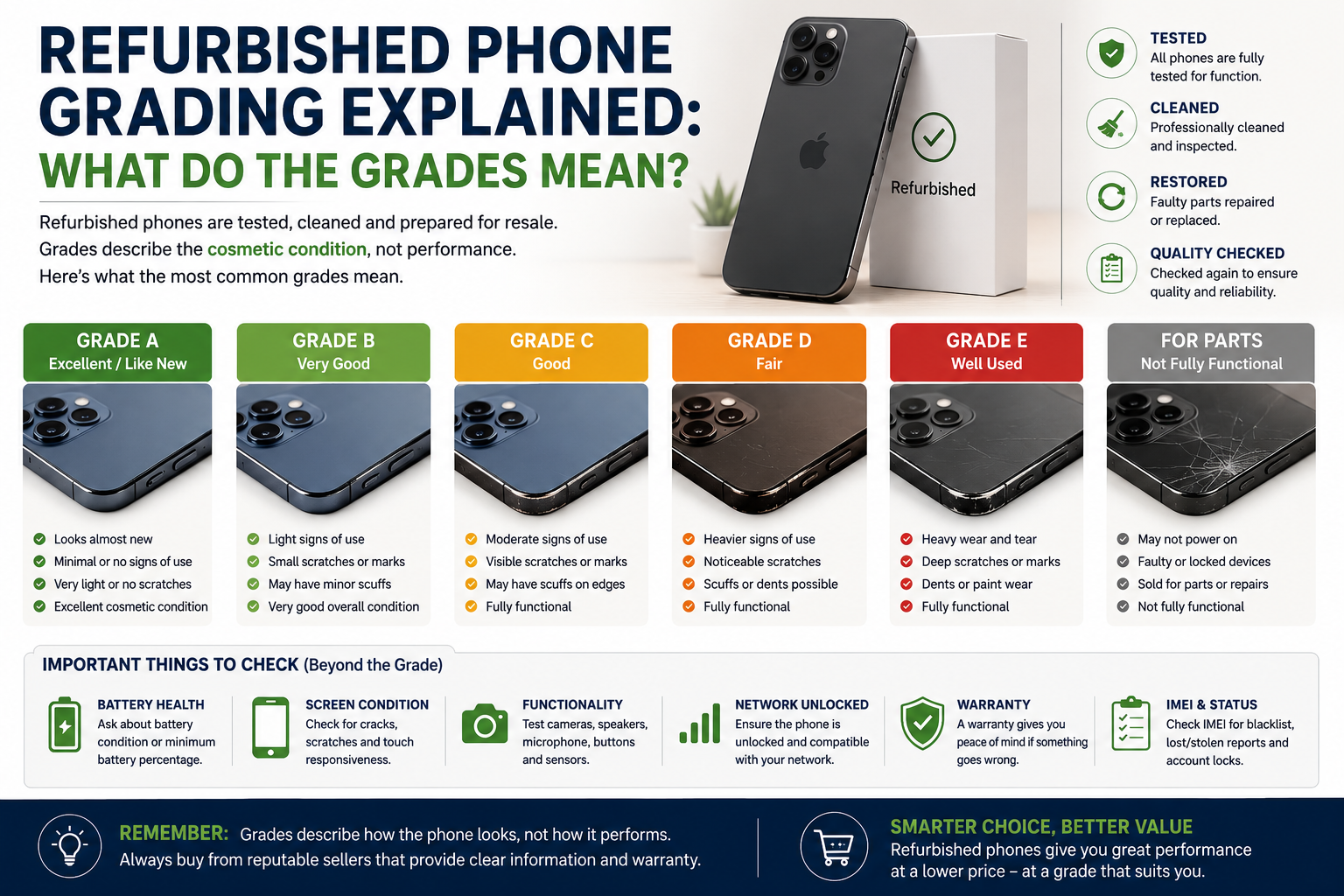
Grade A generally represents one of the best cosmetic conditions available for a refurbished phone.
A Grade A device will typically have very few signs of previous use. It may look close to new, although it isn’t necessarily completely flawless.
You might expect:
- Minimal cosmetic marks
- Little or no noticeable scratching
- A clean and well-maintained exterior
- A screen in very good condition
- Fully tested functionality
Some sellers may use terms such as “Excellent,” “Pristine,” or “Like New” instead of Grade A.
However, always check the seller’s specific definition.
Is Grade A the same as brand new?
Not necessarily.
A Grade A phone may look almost new, but it has previously been owned, returned, or used. Its accessories, packaging, battery condition, and warranty may also differ from those of a brand-new phone.
What Is Grade B?
Grade B usually describes a refurbished phone with some visible signs of previous use.
The device should still be fully functional, but you may notice minor cosmetic imperfections.
These could include:
- Light scratches
- Small marks or scuffs
- Minor signs of wear around the edges
- Slight cosmetic imperfections on the back
For many buyers, Grade B offers an attractive balance between price and condition.
If you’re more concerned about how the phone performs than whether it has a few small marks, a Grade B device could provide good value.
What Is Grade C?
Grade C generally indicates a phone with more noticeable cosmetic wear.
A Grade C phone may have:
- More visible scratches
- Larger scuffs
- Signs of heavier previous use
- Cosmetic wear around the frame or back
- More noticeable imperfections
The important distinction is that cosmetic condition doesn’t necessarily mean the phone performs poorly.
A properly refurbished Grade C phone can still function normally.
For buyers who want the lowest possible price and don’t mind visible signs of use, Grade C can sometimes be an economical option.
What Does “Excellent” Mean?
Some sellers don’t use letter grades at all.
Instead, you may see descriptions such as:
- Excellent
- Very Good
- Good
- Fair
- Like New
An Excellent phone generally has minimal cosmetic wear and is often comparable to a high-grade refurbished device.
But again, don’t assume every seller uses the same definition.
Always read the condition description provided by the individual seller.
What Does “Very Good” Mean?
A Very Good phone will generally show some signs of previous use but should remain in good overall cosmetic condition.
You may see small scratches or marks that aren’t immediately noticeable.
This condition can be a good choice if you want a phone that looks well cared for while saving money compared with a new device.
What Does “Good” Mean?
A phone described as Good will usually have more noticeable signs of use.
You may see scratches, scuffs, or other cosmetic imperfections.
However, the phone should still meet the seller’s stated functionality requirements.
If appearance isn’t your top priority, a Good-condition phone can offer significant savings.
What Does “Fair” Mean?
Fair usually represents a device with more obvious cosmetic wear.
This could include:
- Noticeable scratches
- Scuffed edges
- Cosmetic marks
- Heavier signs of previous use
The exact condition varies by seller, so photographs and a detailed description are particularly important when buying a phone in this category.
Does the Grade Tell You About Battery Health?
Not necessarily.
This is one of the most important things to understand when buying a refurbished phone.
A cosmetic grade primarily describes the physical appearance of the device. It doesn’t automatically tell you how healthy the battery is.
Two phones with the same cosmetic grade could have different battery conditions.
Before buying, ask:
- What is the battery health?
- Has the battery been replaced?
- Is the battery original?
- Does the seller provide a minimum battery-health guarantee?
For phones with built-in batteries, battery condition can have a major impact on how useful the device is.
Does a Higher Grade Mean Better Performance?
Not necessarily.
A Grade A phone isn’t automatically faster than a Grade B phone of the same model.
The grade generally relates more to condition and appearance than performance.
For example, a Grade B phone and Grade A phone of the same model may have identical processors, storage, cameras, and software.
The difference could simply be that one has more visible cosmetic wear.
What Should You Check Besides the Grade?
The grading label is only one part of the buying decision.
Before purchasing a refurbished phone, consider the following.
1. Battery Health
Battery condition can make a significant difference to everyday use.
Ask the seller for specific battery information rather than relying only on the cosmetic grade.
2. Screen Condition
Check whether the screen is:
- Original or replaced
- Free from cracks
- Free from major scratches
- Fully responsive to touch
- Showing normal colours and brightness
3. Cameras
Test the front and rear cameras if possible.
Check focus, flash, video recording, and image quality.
4. Charging Port
A damaged or worn charging port can cause frustrating problems.
Make sure the phone charges correctly and that the connection isn’t unusually loose.
5. Speakers and Microphone
Test both call audio and general speaker output.
A phone may look excellent externally while still having an underlying hardware issue.
6. Network and SIM Compatibility
Make sure the phone is compatible with your network.
Check whether it is:
- Unlocked
- SIM-free
- Compatible with your carrier
- Compatible with the required network technology
7. IMEI and Device Status
The IMEI is a unique identifier associated with a mobile device.
Where appropriate, buyers should verify that the phone isn’t reported lost or stolen and that there aren’t account or activation restrictions that could prevent normal use.
8. Warranty
A warranty can provide valuable protection if something goes wrong after purchase.
Check:
- Warranty length
- What is covered
- What isn’t covered
- Whether accidental damage is excluded
- How repairs or replacements are handled
Is a Grade B Phone Worth Buying?
For many people, yes.
If the phone has been properly tested and the cosmetic marks don’t bother you, Grade B can offer an excellent balance between condition and price.
You could potentially save money without making significant compromises in everyday performance.
The key is to make sure the seller clearly explains what the grade means.
Is It Worth Buying a Grade C Phone?
It depends on your priorities.
If you want the cheapest possible refurbished phone and don’t mind scratches or cosmetic wear, Grade C could make sense.
However, pay particular attention to the phone’s battery, screen, functionality, warranty, and repair history.
A lower cosmetic grade shouldn’t automatically mean lower functionality — but you should verify exactly what you’re buying.
Why Refurbished Phone Grades Can Be Confusing
The biggest problem with grading systems is that there isn’t one universal standard.
For example, one seller might classify a phone with minor scratches as Grade A, while another might classify the same device as Grade B.
That’s why the letter or label alone isn’t enough.
A trustworthy seller should provide a clear explanation of its grading criteria and, where possible, photographs or detailed descriptions of the actual device.
Refurbished vs Used: What’s the Difference?
A refurbished phone and a used phone aren’t necessarily the same thing.
A standard used phone may simply be resold in the condition it was received.
A refurbished phone has generally undergone some form of inspection, testing, cleaning, or repair before being offered for resale.
However, refurbishment standards vary.
Always ask what work has actually been performed rather than assuming the word “refurbished” guarantees that every component has been replaced or renewed.
How to Choose the Right Refurbished Phone Grade
The best grade for you depends on your priorities.
Choose a higher grade if:
- You want the phone to look close to new
- Cosmetic condition matters to you
- You’re willing to pay more for a better exterior
Consider a mid-level grade if:
- You want a balance between price and appearance
- Minor scratches don’t bother you
- You want to maximise value
Consider a lower grade if:
- Price is your main priority
- You don’t mind visible cosmetic wear
- You’re more interested in functionality than appearance
Regardless of the grade, always check the battery, functionality, warranty, and seller’s refurbishment standards.
Final Thoughts
Refurbished phone grades can make buying a pre-owned device easier, but they shouldn’t be the only factor you consider.
Grade A, B, C, Excellent, Very Good, and Good can mean different things depending on the seller.
Before buying, find out exactly what the grade represents, check the battery condition, confirm the phone’s functionality, verify network compatibility, and look at the warranty.
A slightly lower-grade phone from a reputable seller can often be a better purchase than a supposedly “Excellent” device from a seller with unclear standards.
The goal isn’t simply to find the highest grade — it’s to find a reliable phone at a price that represents good value.
Lorem ipsum dolor sit amet, consectetur adipiscing elit. Ut elit tellus, luctus nec ullamcorper mattis, pulvinar dapibus leo.